Imperial Japanese Army
The Narrow Road to the Deep NorthThe Imperial Japanese Army is the institution that turns the Japanese Empire’s strategic need for a railway into a system of forced labor. In the novel, its authority reaches from high-level plans for a supply route to the counting, selection, and work demands imposed on prisoners in jungle camps. The railway becomes both an engineering project and an expression of imperial belief: its construction is treated as imperative, while the people made to build it are counted as expendable resources.
Strategic Purpose and Imperial Ambition
The railway is conceived amid Japan’s worsening military position. After the fall of Singapore in 1942, the Japanese Empire faces Allied control of the seas and the use of Burma as a route for supplies to the Chinese Nationalist Army. The Army’s leaders seek a land connection that can supply Japanese forces in Burma and support their ambitions toward India. The novel presents the project as a response to acute strategic pressure, but also as an undertaking sustained by confidence that imperial will can overcome limits of money, machinery, and time.
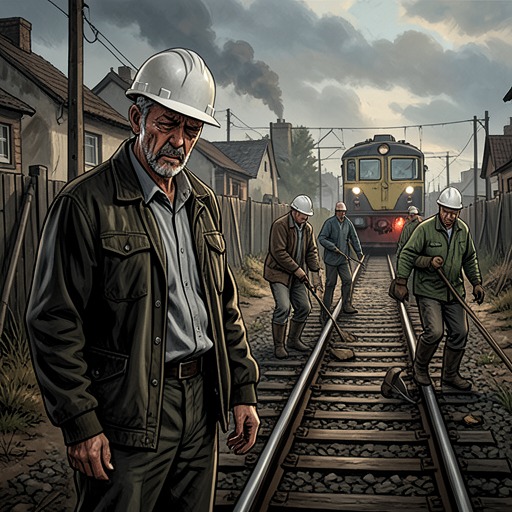
In early 1943, Imperial Japanese Army engineers mark the intended route with surveyors’ pegs. The line is planned to run 415 kilometres from north of Bangkok through to Burma. At first it exists in plans, orders, and exhortations; prisoners are then handed axes and rope and assigned to clear a kilometre of teak forest. This transition from map to compulsory work captures the Army’s reach: a distant strategic decision becomes a physical demand placed on men who have no choice about taking part.
Engineering Orders and Material Constraints
The railway project is characterized by a mismatch between its required output and the resources available to construct it. The Army lacks the money and machinery for ordinary railway building, and the work proceeds with poor hand tools and laborers rather than adequate mechanization. In the wet season, a flooded river becomes unsafe for heavy transport and the road is often impassable. Supplies dwindle, while disease and exhaustion further reduce the number of prisoners able to work.
The demands do not ease in response to these conditions. During construction, the Railway Command Group changes Major Nakamura’s plans for a major cutting that is already half-completed: it orders the cutting enlarged by a third to address gradient problems in the next sector. The change requires an additional 3,000 cubic metres of rock to be cut and removed. Nakamura notes the lack of adequate saws and axes for clearing and the prisoners’ reliance on hand tools for rock work. The order illustrates how engineering targets are transmitted down the command structure even when local conditions make them difficult to meet.
Command, Camp Administration, and Labor
The Army’s authority is exercised through officers, guards, work orders, inspections, and repeated counts. At the camp, Lieutenant Fukuhara oversees a prisoner selection in the presence of Major Nakamura. Dorrigo Evans, acting as both senior medical officer and prisoners’ commanding officer, reports 838 men remaining, including prisoners with cholera, men hospitalized with serious illness, and others fit only for light duties. He calculates that 363 are available for railway work. When negotiations continue, he offers 400, using his medical judgment to resist a larger demand, though he recognizes that this argument provides no reliable protection for the sick.
The Army’s labor system is also marked by hierarchy. The novel describes lower-ranking prisoners being compelled to work while officers remain in camp and receive a very small salary. Dorrigo Evans uses the officers’ position pragmatically, requiring them to help with care for the sick, sanitation, drainage, water carrying, and camp maintenance. This local arrangement shows that hierarchy can shape who is assigned to labor, but it does not remove the Army’s control over the prisoners’ conditions or over the number demanded for railway work.
That control extends to selection for further labor. Major Nakamura orders that 100 men be chosen to march to a camp near Three Pagoda Pass, despite Dorrigo’s warning that no prisoner is fit for the journey. Nakamura’s stated calculation is that the march will save rice for the Japanese Army. Dorrigo understands that if he leaves the choice to Nakamura, the sickest men may be selected; choosing the party himself offers a chance to send men with a better prospect of surviving, although he expects most to die. The order makes the Army’s logistical accounting a direct moral conflict for the prisoners’ commander.
Ideology and the Cost of Obedience
The Army’s methods are supported by an ideology of devotion and endurance. Major Nakamura had initially taken pride in his role in what he regarded as a historic national mission. The project joined his professional identity to the Emperor and the imperial destiny. In the camp, he presents health as a matter of will and treats failure to meet objectives as shameful, framing devotion through death as an ideal. The novel sets that doctrine against the reality of illness, inadequate food, and the diminishing capacity of the prisoners.
The Army’s own personnel are also shown operating within this ideology. Tomokawa tells Nakamura that the Imperial Japanese Army supplies him with a stimulant to assist the Empire’s work. Nakamura, reflecting on the railway, continues to regard its construction as a triumph of Japanese spirit, even as he recognizes that he could be held responsible for the deaths of prisoners and other laborers. His reasoning—that the railway had to be built for the Emperor and could not have been built another way—shows how obedience and imperial purpose can be used to frame human losses as unavoidable. The narrative does not make that rationale equivalent to innocence: Nakamura also confronts the distance between his ideal of goodness and the cruelty he has been capable of accepting.
Defeat, Dissolution, and Commemoration
The Army’s railway loses its military purpose with Japan’s defeat. After the war, Japanese engineers and guards responsible for the line are imprisoned or repatriated, while the laborers who remain are freed. The railway is abandoned by the Thais, dismantled by the English, and taken up in parts by local tribespeople. Its banks and bridges deteriorate, and its cuttings fill in. The project that demanded the Army’s labor system does not endure as the permanent achievement its planners intended.
The novel places that physical decline beside the uneven preservation of wartime memory. Steam locomotive C 5631, the first train to travel the completed railway on 25 October 1943, is displayed in a museum associated with Yasukuni Shrine in Tokyo. The shrine’s Book of Souls includes the names of more than two million people who died in service to the Emperor, among them 1,068 men convicted of war crimes and executed after the war; some of those men were found guilty of mistreating prisoners on the railway. Yet the locomotive’s plaque does not mention the conditions of construction or the dead laborers. The novel also emphasizes that estimates of deaths among the hundreds of thousands who worked on the railway vary widely, and that many laborers have no memorial book recording their names. The Army’s legacy is therefore presented not only in the railway’s ruins, but in the contrast between a preserved emblem of national achievement and the people left out of its commemorative account.